Lean Visual Management helps teams see problems early, act faster, and stay aligned during daily operations.
When done right, it becomes the backbone of your Daily Management System – turning KPIs into decisions and problems into actions.
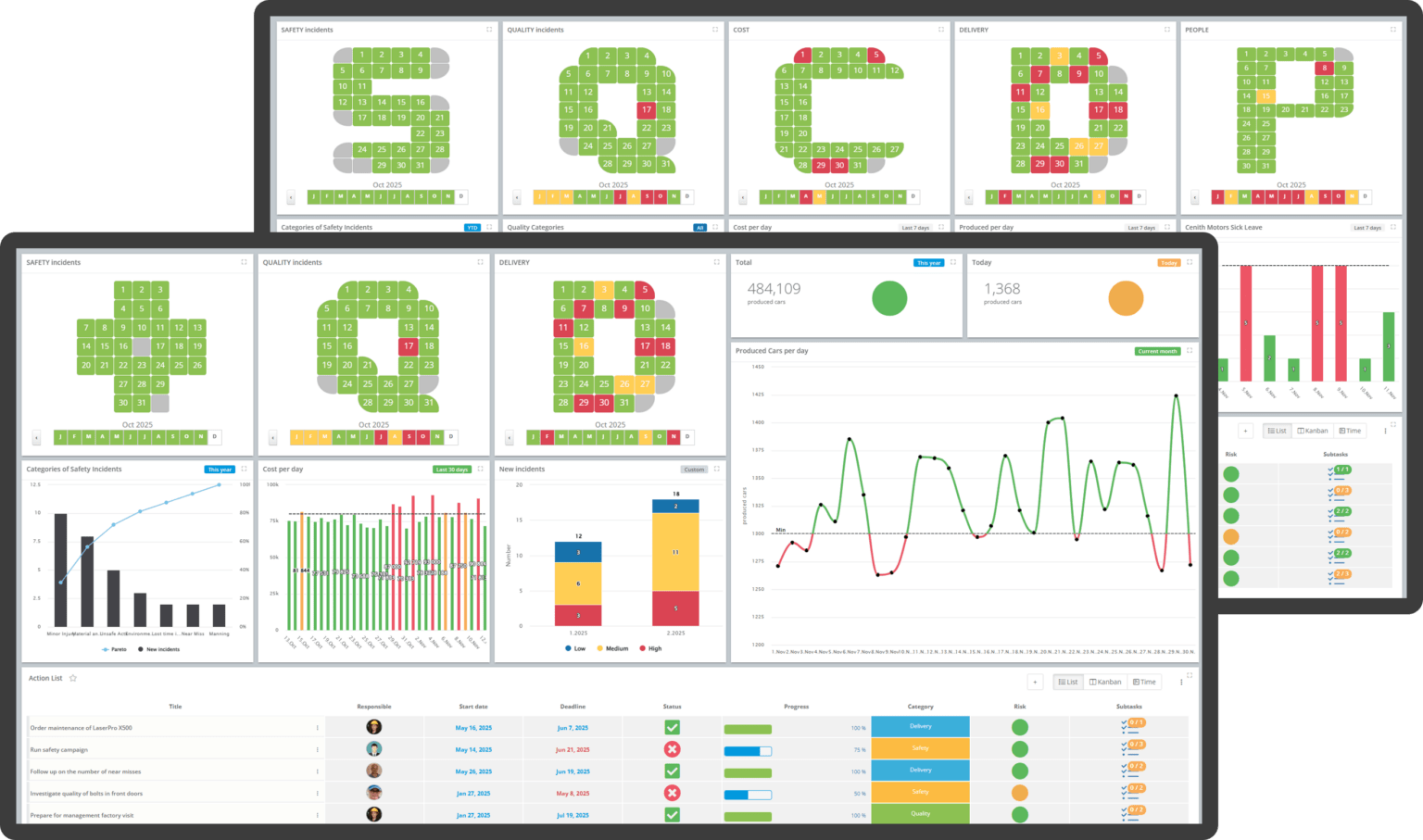
Visual management is not just boards – it’s how teams control daily performance in real time.
It allows operators and managers to instantly answer:
Key outcome: Faster decisions during the shift – not after it.
To support daily operations, your visual system must connect performance → issues → action.
| Element | Purpose in Daily Operations | What Good Looks Like |
|---|---|---|
| KPIs | Show performance vs. plan | Updated during the shift |
| Visual signals | Highlight deviations | Clear red/yellow/green status |
| Issues | Capture problems | Logged in real time |
| Actions | Solve problems | Assigned with owner + deadline |
👉 If one element is missing, daily management breaks down.
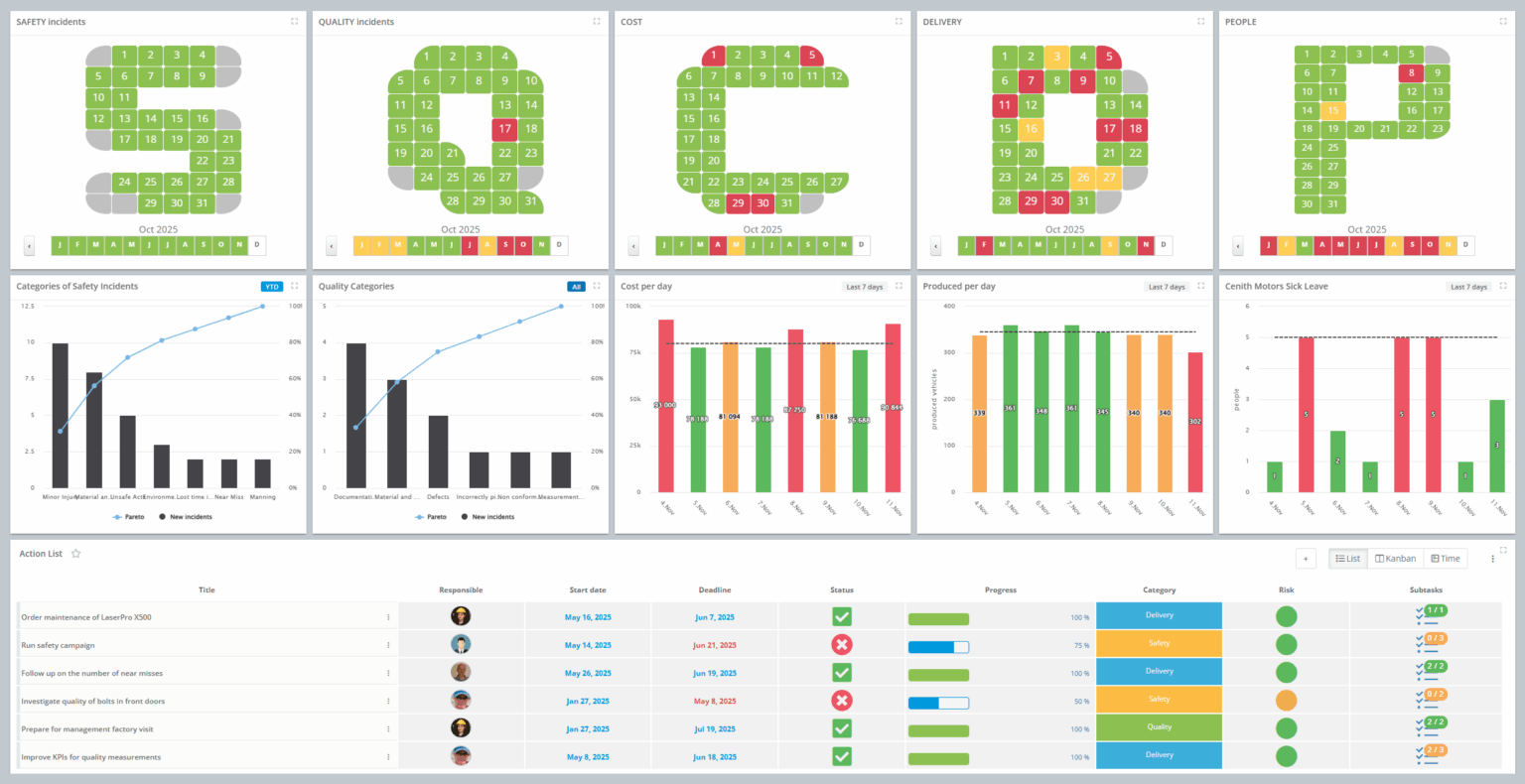
SQCDP boards structure daily performance across key operational areas.
| Area | Daily Question | Example Indicator |
|---|---|---|
| Safety | Are we operating safely today? | Incidents / near misses |
| Quality | Are we producing correctly? | Defects / deviations |
| Cost | Are we efficient? | Scrap / resource usage |
| Delivery | Are we meeting demand? | Output vs. plan |
| People | Are teams fully operational? | Staffing / absence |
How it connects to operations:
A visual board only works if it drives structured daily execution.
| Step | Focus | Outcome |
|---|---|---|
| Review KPIs | Spot gaps vs. plan | Identify where to act |
| Focus on red | Ignore green KPIs | Prioritize issues |
| Define actions | Assign owner + deadline | Ensure accountability |
| Escalate | Raise blockers | Avoid delays |
✅ Keep meetings operational – not analytical.
In many plants, problems are logged too late. Visual management fixes this by capturing issues as they happen.
Impact: Problems are handled within hours – not after the shift.
Visibility alone is not enough – execution is what improves performance.
| Weak Setup | Strong Visual Management |
|---|---|
| Problems discussed | Problems tracked |
| Actions optional | Actions assigned |
| No ownership | Clear owner per issue |
| No follow-up | Status visible to all |
Actions are tracked directly on the board:
| Issue | Action | Owner | Status |
|---|---|---|---|
| Line stoppage | Check root cause | Technician | In progress |
| Quality deviation | Inspect batch | QA | Open |
➡️ Everyone sees progress without chasing updates.

Traditional boards often fail in daily operations because they lag behind reality.
| Limitation | Operational Impact |
|---|---|
| Manual updates | Outdated decisions |
| Paper-based tracking | Missing data |
| No escalation flow | Slow response |
Result: Managers act during the shift – not after it.
Daily operations don’t happen in isolation. Delays and inefficiencies often occur between teams or across sites.
Visual management must therefore extend beyond the local board to provide shared visibility across the organization.
| Challenge | Impact on Operations | With Visual Management |
|---|---|---|
| Siloed information | Slow response to issues | Shared, transparent data |
| Unclear dependencies | Delays between teams | Better coordination |
| Local problem-solving only | Repeated issues | Faster escalation |
| Limited management overview | Late decisions | Real-time overview |
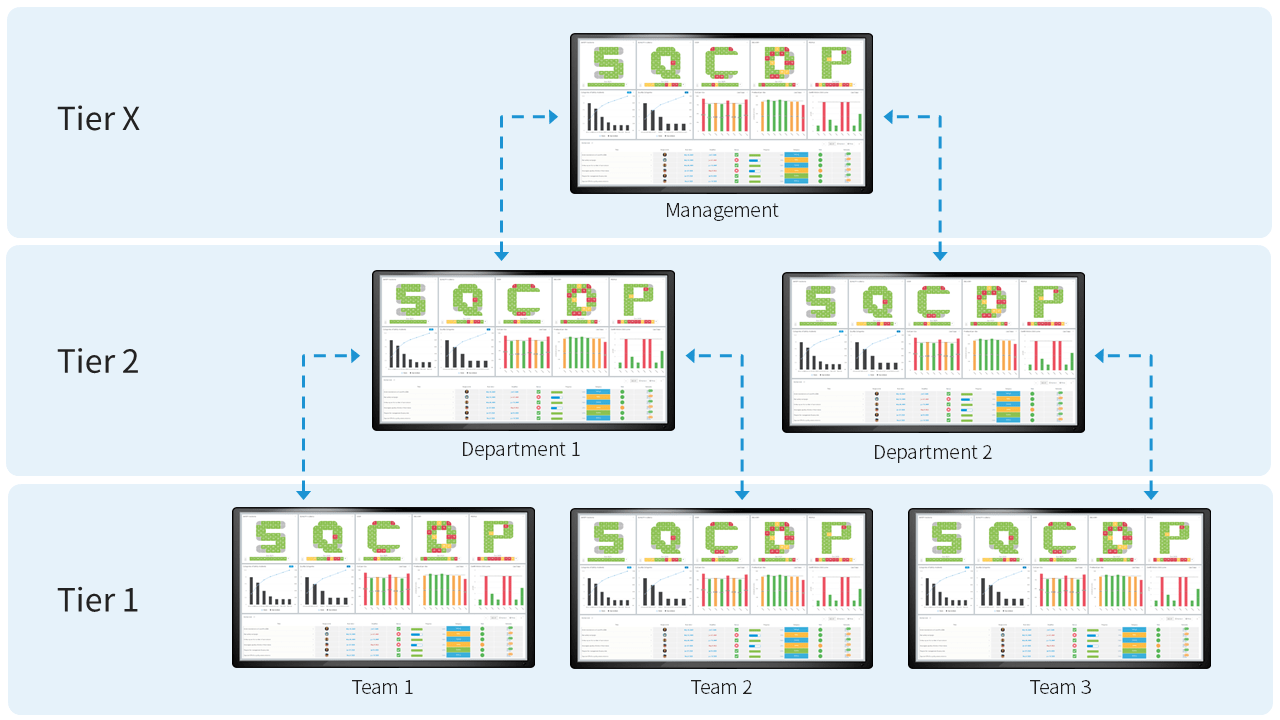
To support daily execution across teams:
| Before Visual Management | After (with DigiLEAN) |
|---|---|
| Issues reported end of shift | Issues logged immediately |
| Delayed decision-making | Real-time actions |
| Manual tracking | Centralized visibility |
| Poor follow-up | Clear ownership and status |
Operational result: Faster response, better output stability.
Lean Visual Management improves daily operations by creating a simple loop:
See → React → Solve → Track
Digital tools like DigiLEAN strengthen this by making the process:
👉 The result is not better boards – but better daily execution on the shop floor.
Focus on what operators can influence during the shift. If they can’t act on it today, it shouldn’t be on the board.
The most common reason is lack of action tracking – teams see problems but don’t follow up.
Yes. Each team needs local control, while management should have visibility across all boards.
Only discuss:
Everything else is waste.
Teams move from reporting performance → managing performance in real time.
Immediately.
The value of visual management comes from acting during the shift – not reporting after it.
You can watch DigiLEAN intro video to learn more, book a demo to walk through the workflow with an expert, or see the platform live by starting a free trial and exploring it yourself.