Root cause analysis (RCA) sounds simple on paper. Something breaks, you ask why enough times, and you land on the real problem. In practice, most manufacturing teams stop asking “why” way too early. They patch the symptom, production restarts, and everyone moves on until the same failure shows up again three weeks later.
If that cycle feels familiar, you are not alone, and you are not doing anything unusually wrong. RCA has a handful of predictable failure points, and once you know what they look like on your shop floor, they get much easier to catch.
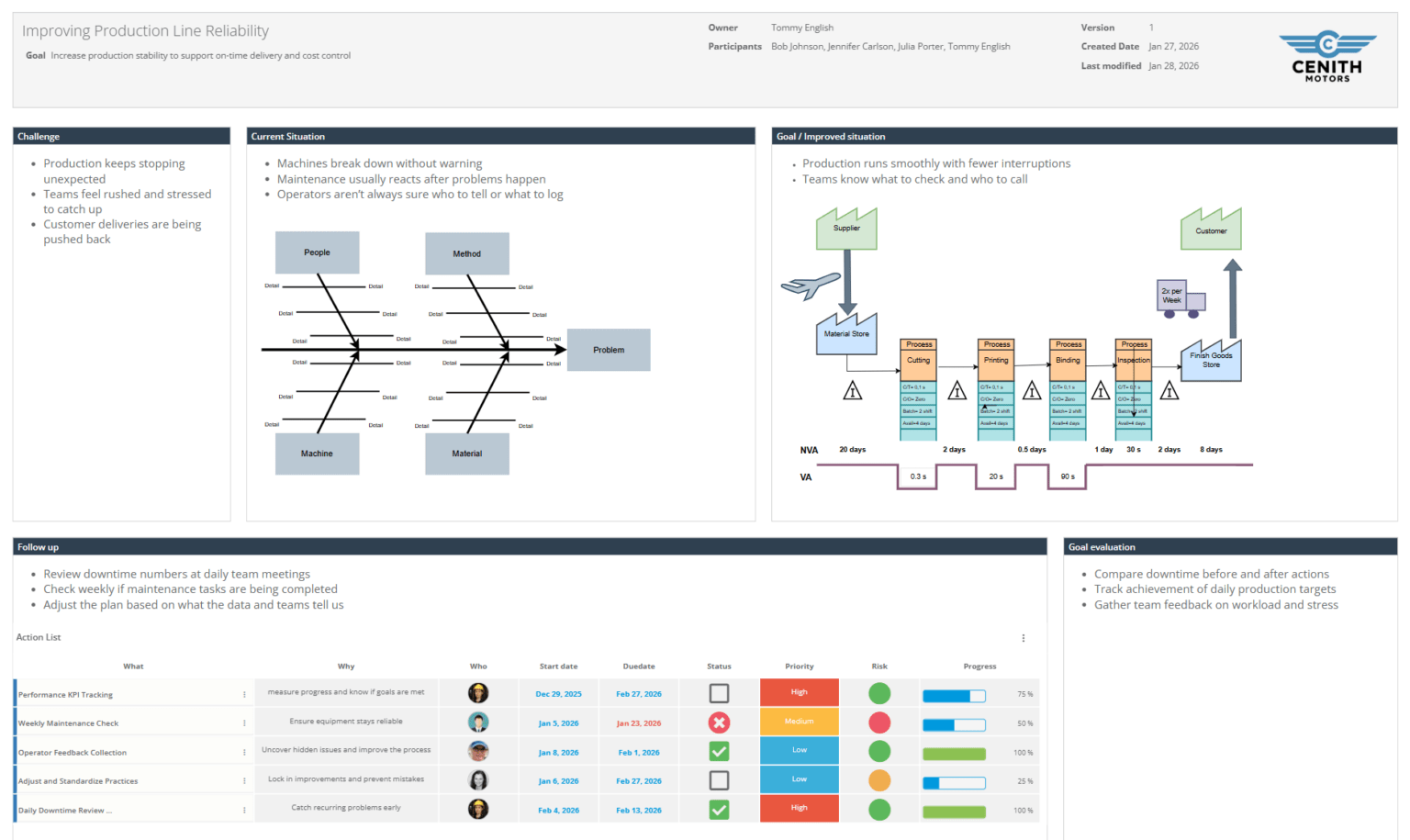
RCA is meant to trace a problem back to its true origin, not just its most visible symptom. A machine jam is a symptom. Late deliveries are a symptom. The actual root cause is usually a few layers deeper, in a process gap, a maintenance schedule, or a data blind spot.
The pressure of a live production line works against that kind of digging. When a line is down, the instinct is to get it running again, not to investigate. That is understandable, and it is also exactly how the same failure ends up back on the schedule next month.
| Mistake | What it looks like on the floor | Why it backfires |
|---|---|---|
| Stopping at the symptom | "The sensor tripped, we cleaned it, done." | The underlying condition that caused the trip is never addressed, so it recurs. |
| Blaming the operator | "Operator error" closes the investigation. | Ignores whether the process itself made the error easy to make. |
| Rushing the investigation | RCA squeezed into a 15-minute huddle. | Not enough time to gather evidence, so the team defaults to the easiest explanation. |
| Skipping data collection | Conclusions based on memory or opinion. | Findings can't be verified, and patterns across shifts or lines get missed. |
| No follow-up after the fix | Corrective action logged, never checked again. | Nobody knows if the fix actually worked until the problem returns. |
A machine overheats. Maintenance swaps the fan. It overheats again a month later. The fan was never the root cause, it was just the part that happened to fail first. Effective root cause analysis goes beyond meetings and assumptions, relying instead on data, structured investigation, and evidence-based validation to find the true cause of recurring problems rather than repeatedly fixing what is visible.
The fix: Push past the first answer. If your team’s RCA process typically stops after one “why,” you are documenting symptoms, not causes.
It’s tempting to close an investigation once someone says, “the operator missed a step.” This mistake usually comes from a rigid belief that if a person didn’t follow a process exactly, that failure to follow it must automatically be the root cause. In reality, failure to follow a process is often a symptom of a process that was too easy to get wrong in the first place.
A useful gut check: look back at your last several RCAs. If more than half land on “operator error,” the process itself is probably the real issue.
Time pressure is not just one item on the list of RCA mistakes, it tends to make every other mistake on the list worse. A rushed RCA skips evidence gathering and pushes teams toward whatever explanation is fastest to write down.
If someone on your team is being asked to complete an RCA in an unreasonably short window, that deadline is worth pushing back on.
Rushing conclusions without enough evidence leads to wrong assumptions, ineffective fixes, and wasted resources chasing the wrong problem. Without data, an RCA is really just a group’s best guess, and best guesses don’t hold up when the same failure shows up on a different shift.
This is one of the areas where digital tools change the equation. When downtime, defects, and delays are logged manually (or not logged at all), teams are reconstructing history from memory. A digital shop floor system that captures SQCDP data automatically gives the RCA team an actual timeline to work from instead of relying on who remembers what.
DigiLEAN in practice: A production team using DigiLEAN’s digital SQCDP boards can pull up the exact shift, machine, and downtime code tied to a defect trend, instead of piecing it together from paper logs or someone’s memory of “sometime last week.”
An RCA that ends with “corrective action implemented” and nothing after that is only half finished. It’s a frequent gap in RCA: solutions get implemented but never monitored, leaving teams unsure whether the fix actually worked.
The fix: Every corrective action needs an owner, a timeline, and a scheduled check back on the KPI it was supposed to move.
DigiLEAN in practice: Teams using DigiLEAN’s action tracking can assign the corrective action directly to the person responsible, set a due date, and see it flagged automatically if it’s overdue, so “we’ll check on it later” doesn’t quietly turn into “we forgot.”
RCA is often run as a single reactive meeting after something goes wrong, rather than a habit built into daily management. When it lives only in someone’s notebook or a one-off email, the findings don’t make it into future tiered meetings, and the same root cause can resurface on a different line without anyone connecting the dots.
DigiLEAN in practice: When RCA findings are logged on a digital board that feeds into daily and weekly tiered meetings, a root cause identified on the day shift is visible to the night shift, the plant manager, and the next SQCDP review, not just the people in the original room.
RCA is the investigation that identifies why a problem happened. A corrective action report documents what will be done to fix it. RCA comes first, and it should directly inform the corrective action, not run as a separate, disconnected exercise.
Anyone close to the problem: the operator who saw it happen, a supervisor with process context, and someone from quality or maintenance depending on the issue. Excluding frontline staff is a common way RCAs end up with an incomplete picture.
It depends on the severity of the issue, but a rushed 10-minute RCA on a recurring or high-cost problem is a red flag. Complex or repeat issues usually warrant a scheduled session with time to review data, not a hallway conversation.
A contributing factor makes a problem more likely or more severe, but removing it alone won’t stop the problem from recurring. The root cause is the underlying condition that, if fixed, prevents the failure from happening again.
No. Minor, one-off issues with no real cost or safety impact usually don’t need a formal RCA. It’s most valuable for recurring problems, high-cost downtime, quality escapes, or safety incidents.
The clearest test is whether the problem stops recurring after the fix is implemented. If a similar issue reappears within weeks or months, the investigation likely stopped one layer too shallow.
You can watch DigiLEAN intro video to learn more, book a demo to walk through the workflow with an expert, or see the platform live by starting a free trial and exploring it yourself.