Running a strong daily management system in one plant is challenging. Standardizing it across multiple locations is even harder.
Many organizations find that each plant develops its own routines: different KPIs, different board structures, and different meeting formats. As a result, leadership struggles to compare performance, share improvements, or identify systemic issues.
Standardizing a Lean daily management system creates alignment across sites while enabling faster problem solving and stronger continuous improvement.
Before standardizing anything, organizations must agree on what daily management is meant to do.
A daily management system should function as the core operational routine where teams:
Daily meetings should not become reporting sessions. Their purpose is to make problems visible and initiate action quickly.
For example, a production team may review safety, scrap, and delivery performance each morning. When a deviation appears, a countermeasure is assigned immediately.
When scaling daily management across plants, the goal is alignment – not total uniformity.
A practical approach is to standardize most of the system while allowing some local flexibility.
Typically standardized
Typically flexible
This balance ensures consistency without removing plant ownership.
A Common KPI Structure
Plants should track performance using the same operational categories, typically:
Shared metrics allow leadership to compare performance and identify cross-plant trends.
A Consistent Meeting Structure
Daily meetings should follow a simple routine:
These meetings are usually 10–15 minutes and focused only on operational abnormalities.
Clear Escalation Paths
Standard escalation ensures issues are solved quickly.
A typical structure might be:
Operator → Team Leader → Department Manager → Plant Leadership
If problems cannot be resolved locally, they move quickly to the next level.
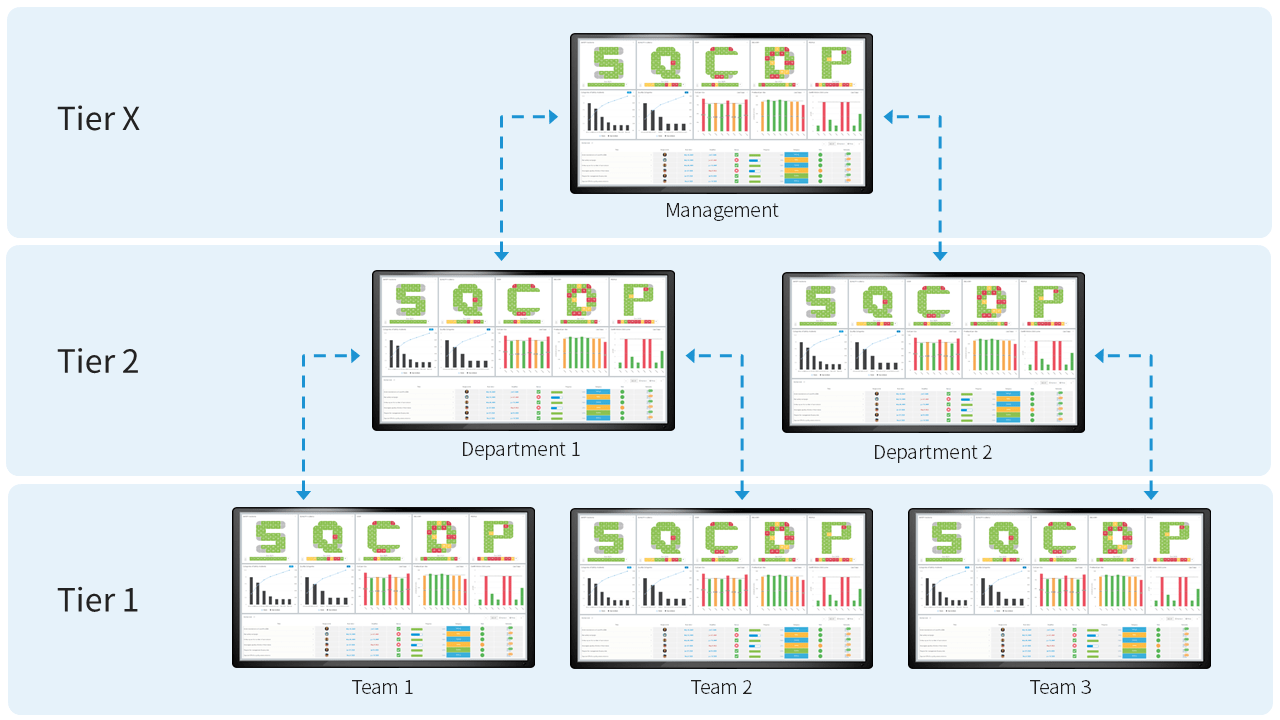
A Standard Daily Board Template
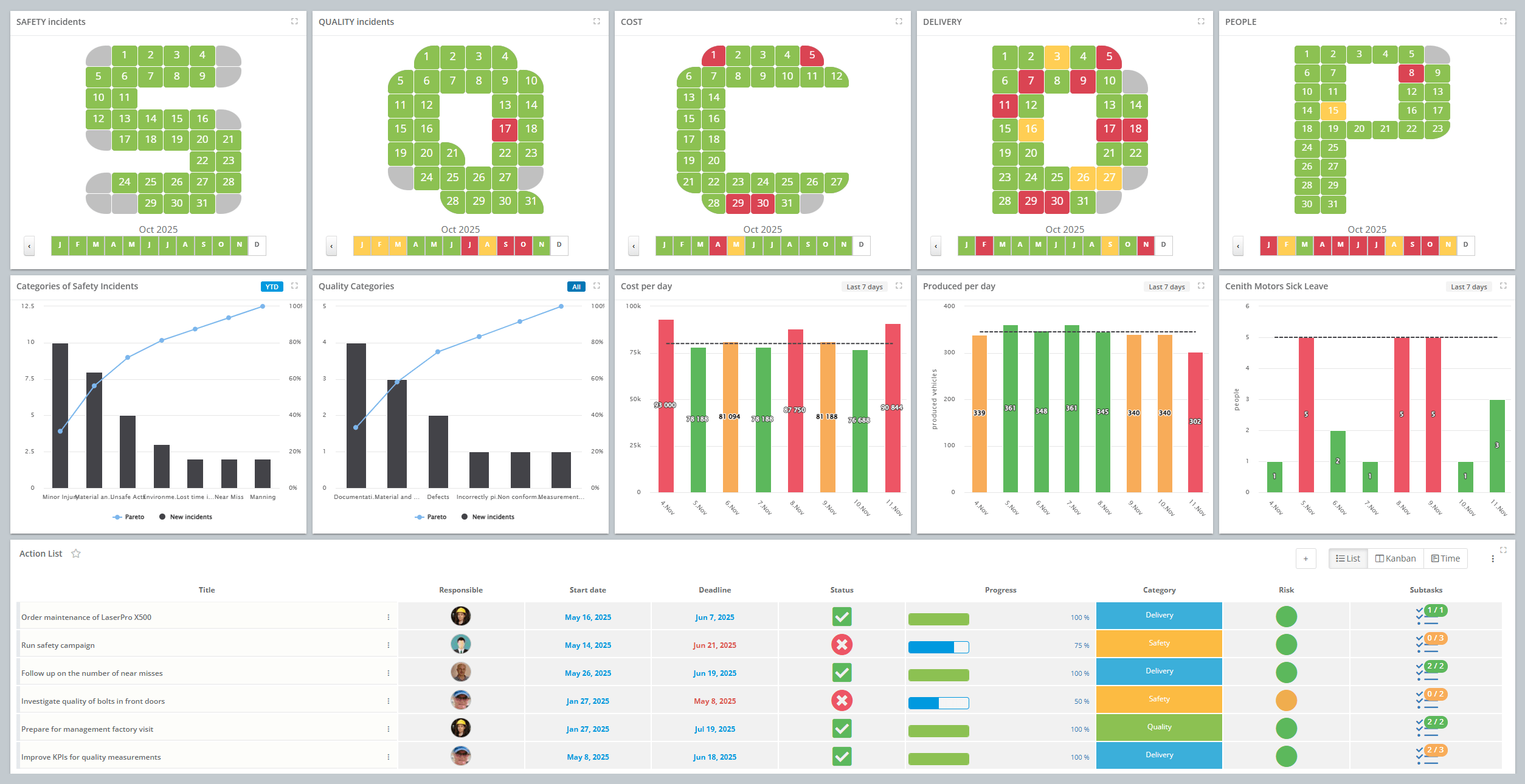
Visual management helps teams understand performance at a glance.
A typical daily board includes:
Using a common structure makes boards easier to interpret across plants.
Digital solutions such as DigiLEAN help organizations standardize board templates through interactive digital boards used during daily meetings.
Many companies start daily management with physical boards or spreadsheets.
While effective locally, manual systems often struggle at scale because they:
Managers often spend more time maintaining reports than improving operations.
Digital platforms make it easier to maintain a consistent daily management system across locations.
The DigiLEAN platform supports this by enabling organizations to run standardized daily management processes across teams and plants.
For example:
These capabilities improve transparency and help maintain consistent daily management practices across locations.
Organizations typically succeed when they implement standardization step by step.
When daily management is standardized across plants:
Daily management becomes a true operational management system rather than just a meeting routine.
A strong example of successful standardization comes from Marquardt Group, an international automotive supplier operating across multiple locations worldwide.
Marquardt had already established strong shop floor management practices, but manual boards created several challenges. Information was scattered, historical data was difficult to analyze, and board formats varied between plants. This made it harder to compare performance and maintain consistent daily management routines across sites.
To address this, the company implemented the DigiLEAN platform to digitalize and standardize their daily management system.
The rollout included:
By using standardized templates and digital boards, Marquardt created a consistent structure for reviewing KPIs, tracking deviations, and managing improvement actions across plants.
Since implementing DigiLEAN, the company has improved transparency, reduced reliance on Excel-based tracking, and enabled teams to analyze deviation patterns over time. The platform has also expanded beyond production to support other operational and strategic processes.
Organizations looking to standardize their Lean daily management system across multiple plants can learn from this approach: establish clear standards, pilot the structure, and use digital tools to maintain consistency across locations.
To learn more about Marquardt’s implementation, read the full customer story.
Standardizing daily management across multiple plants is essential for scaling operational excellence.
By defining shared structures, aligning meeting routines, and supporting the process with digital tools like DigiLEAN, organizations can build a Lean daily management system that improves transparency, accelerates problem solving, and strengthens continuous improvement across locations.
This is typically managed through strong governance, regular audits, and a clear ownership model for maintaining global standards. Standard templates and periodic alignment reviews help keep all sites consistent.
Data consistency is usually achieved by defining strict KPI definitions, automating data capture where possible, and reducing manual entry. Clear rules for how metrics are calculated are essential.
It should be a combination:
This balance ensures both scalability and relevance.
Key signals include faster issue resolution, fewer repeated problems, improved cross-site benchmarking, and increased usage of standardized boards and routines.
Timelines vary, but most organizations see early stabilization in pilot sites within a few months, with full scaling across plants typically taking 6–18 months depending on complexity.
You can watch DigiLEAN intro video to learn more, book a demo to walk through the workflow with an expert, or see the platform live by starting a free trial and exploring it yourself.