Table of Contents

Digital Daily Management Implementation Guide

A Proven, Scalable Approach to Digitalizing Daily Management Across the Organization
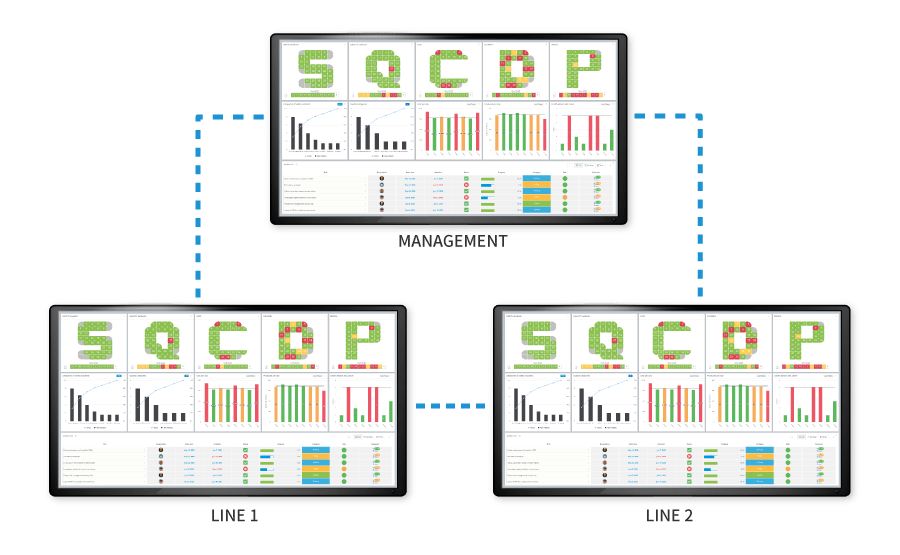
Tier structure DigiLEAN

Overview: Purpose and Scope of This Guide

This guide provides a structured approach to implementing digital daily management across teams, sites, and functions. 

It is designed to help organizations: 

  • Transition from manual to digital daily management 
  • Establish standardized daily management practices 
  • Enable consistent execution across locations 
  • Improve transparency, follow-up, and collaboration 
  • Scale continuous improvement beyond the shop floor 

The approach outlined in this guide is based on real implementation experience and reflects what is required to achieve both adoption and long-term value. 

The core principle behind implementation success: 

“The method comes first. The tool enables it.”

Phase 0 – Establish the Right Foundations

1. Clarify the Role of Daily Management System 

Before introducing any digital tools, ensure clear alignment that daily management: 

  • Is the core leadership routine 
  • Is where:  
  • KPIs are reviewed daily 
  • Deviations are identified 
  • Improvement actions are triggered 
  • Acts as the starting point for all CI activities 

✅ Takeaway 
Do not digitalize chaos. Ensure daily management already exists as a structured process. 

2. Agree on a Standardization Philosophy (80/20 Rule) 

A strong implementation starts with clear standardization principles: 

  • ~80–90% of daily shop floor meetings are globally standardized 
  • ~10–20% is local flexibility 
  • Daily cadence is standardized first 
  • Weekly/monthly structures can evolve later 

✅ Takeaway 
Avoid over‑customization. A strong global standard accelerates rollout and learning. 

Phase 1 – From Manual to Digital Thinking

3. Accept That Digital ≠ Analog Copy 

A key lesson learned: 

  • Manual boards cannot be copied 1:1 into digital tools 
  • Visual elements (magnets, colors, paper flow) must be re‑thought 
  • Users need time to adapt from physical logic to digital logic 

✅ Takeaway 
Plan for process translation, not just tool configuration. 

4. Make the Business Case for Digital 

Organizations typically see clear benefits from digital daily management: 

  • Higher engagement in deviation logging 
  • Centralized task and countermeasure tracking 
  • Full historical visibility (patterns over weeks/months) 
  • Ability to scale daily management beyond production 
  • Easier reporting and transparency across locations 

✅ Takeaway 
Digital daily management is about learning, not decoration. 

Phase 2 – Pilot First, Then Scale

5. Start with a Controlled Pilot Area

A structured pilot approach should include:

  • One pilot area
  • One board
  • Learn what works and what doesn’t
  • Adjust structure, logic, and templates
  • Stabilize before broader rollout

Following best practices in early-stage implementation:

  • Start with manual KPI updates to establish the right standards and meeting structure
  • Focus on consistency in how data is reviewed and discussed
  • Introduce integration and automation after the standard is stable and proven

✅ Takeaway
Pilots reduce rollout risk and create internal credibility.

6. Define the “Minimum Standard Template”

After pilot learning:

  • Define a baseline daily management board
  • Include only essential elements, such as:
    • SQCDP overview
    • Attendance & communication
    • Safety & quality deviations
    • Performance tracking
    • Escalations & actions
    • Standard work (e.g. T-cards)

✅ Takeaway
A clear template = faster adoption + easier training.

Phase 3 – Prepare the Organization

7. Identify Key Roles Early 

Clearly define: 

  • Global owner (HQ Lean / CI) 
  • Local key users per plant 
  • Clear responsibility for rollout and support 

✅ Takeaway 
Tool adoption fails without clear ownership. 

8. Build a Lightweight Governance Model 

Key governance elements: 

  • Naming conventions for boards 
  • Rules for creating new boards 
  • Template usage guidelines 
  • Clear escalation paths 

✅ Takeaway 
Flexibility must be balanced with governance – especially at scale. 

9. Ensure Early IT Alignment 

To enable a smooth and scalable rollout, align early with IT on key enablers: 

  • Single Sign-On (SSO) and access management  
  • Security requirements and compliance  
  • Integration needs with existing systems  

 Takeaway 
Early IT alignment reduces implementation friction and ensures a secure, scalable setup. 

Phase 4 – Global Rollout Execution

10. Choose the Right Rollout Strategy 

Two typical rollout scenarios:

First digital rollout (manual → digital):

  • Slower 
  • Focused on learning and mindset change 
  • ~3 months per location 

Second digital rollout (digital → digital): 

  • Faster 
  • Logic already understood 
  • Global rollout time ~2 months 

✅ Takeaway
Migration speed depends heavily on digital maturity, not company size. 

11. Prioritize One‑on‑One Plant Support 

A critical success factor during rollout: 

  • Regular one-on-one sessions with each site  
  • Avoid relying solely on large group calls  
  • Address site-specific questions and challenges directly  
  • Provide hands-on support tied to real daily management routines  

✅ Takeaway
Adoption quality improves through targeted, site-specific support. 

12. Establish Cross-Site Learning Routines 

To strengthen adoption and enable internal knowledge sharing: 

  • Establish regular cross-site forums (e.g., monthly) where CI/Opex or operational leaders:  
  • Share experiences and challenges  
  • Align on best practices  
  • Learn from different implementations 

✅ Takeaway
Scaling success requires structured internal learning – not just local optimization. 

13. Train Remotely – But Intentionally 

Effective training includes: 

  • Structured remote coaching 
  • Clear agendas for every session 
  • Focus on how teams run daily management routines 
  • Practical, hands-on learning 

✅ Takeaway
Digital rollouts don’t require travel – but they do require structure. 

14. Maintain Structured Vendor Follow-Up 

To ensure the platform continues to deliver value: 

  • Establish recurring meetings with the system provider  
  • Use these sessions to:  
  • Review rollout status and adoption  
  • Address user questions and challenges  
  • Align on integrations and technical topics  
  • Identify opportunities for improvement and further use  

 Takeaway
Ongoing collaboration with the platform provider ensures continuous improvement, better system utilization, and alignment with evolving needs. 

Phase 5 – Hardware & Physical Setup

15. Standardize, but Don’t Over‑Engineer 

Recommended hardware principles: 

  • IT-approved standard setups  
  • Large, mobile screens  
  • Touchscreens only where they add value  
  • Optional cameras for remote participation  

✅ Takeaway 
Visibility and mobility matter more than high‑end equipment.  

Phase 6 – Value Expansion After Go‑Live

16. Eliminate Excel Gradually 

After stabilization: 

  • Replace Excel-based task tracking with digital boards  
  • Automate reporting where relevant  
  • Create a single source of truth for KPIs and deviations 

✅ Takeaway 
Do not migrate everything on day one – let value drive adoption. 

17. Expand Beyond the Shop Floor 

Once stabilized, expand into: 

  • Administrative teams 
  • Strategic roadmaps 
  • Departmental initiatives 
  • Value‑based execution tracking (Cost, Culture, Growth) 

✅ Takeaway 
Digital shop floor management becomes a management system, not just a tool. 

Phase 7 – Long‑Term Success Principles

18. Embrace the 80% Solution Mindset 

A key long-term principle: 

  • Do not expect 100% fit on day one 
  • Accept strong standard coverage 
  • Improve iteratively based on real use 

✅ Takeaway 
Perfection kills momentum. Iteration builds excellence.

Summary: Proven Implementation Flow

1. Align on purpose and standards 
2. Translate process, not paper 
3. Pilot, learn, stabilize 
4. Define strong templates 
5. Prepare roles and governance 
6. Roll out with focused plant support 
7. Standardize hardware pragmatically 
8. Expand value after adoption 

Case Study: Marquardt

A strong example of successful digital daily management implementation is Marquardt Group, a global automotive supplier operating across multiple sites and time zones. 

Marquardt successfully: 

  • Transitioned from an existing digital solution after benchmarking multiple alternatives  
  • Leveraged already well-established daily management practices and structure  
  • Achieved a fast and scalable global rollout in 10 locations across 5 continents 
  • Enabled consistent daily management across locations  
  • Expanded usage beyond production into administrative and strategic processes  

A key success factor was their ability to combine: 

  • Strong standardization  
  • Clear ownership and governance  
  • Continuous learning across sites  
  • Structured follow-up with their Lean software provider DigiLEAN 

Read the full customer story

To explore how Marquardt approached their implementation in detail, including rollout strategy, adoption, and resultsread the full customer story.

FAQ: Digital Daily Management Implementation

How long does it typically take to implement a solution for digital daily management?

Implementation timelines vary depending on organizational maturity, but most companies see initial pilot results within a few weeks. A full rollout across multiple sites typically takes a few months, depending on standardization and available resources.

Common pitfalls include:

  • Trying to digitalize unstable or unclear processes
  • Over-customizing too early
  • Focusing too much on tools instead of routines
  • Rolling out too fast without proper pilot learning

Avoiding these helps ensure sustainable adoption.

It should be a combination:

  • Central teams define standards, templates, and governance
  • Local teams adapt within defined boundaries

This balance ensures both scalability and relevance.

Typical indicators include:

  • Consistency of daily management routines
  • Increased visibility of KPIs and deviations
  • Improved follow-up on actions and improvements
  • Reduction in manual reporting and coordination effort

The focus should be on behavioral and process improvements – not just system usage.

Post go-live support typically includes:

  • User support and coaching
  • Governance and template updates
  • Alignment with IT and integrations
  • Continuous improvement of workflows

Ongoing support is essential to maintain value and engagement.

Ready to strengthen your daily management?

Discover how to improve daily management with DigiLEAN