For many manufacturers, continuous improvement starts strong in a single plant but loses momentum when expanding across multiple sites. Different processes, local practices, disconnected reporting systems, and varying levels of Lean maturity make it difficult to maintain consistency.
This article explains how manufacturing leaders can scale continuous improvement across plants while maintaining local ownership and driving measurable results.
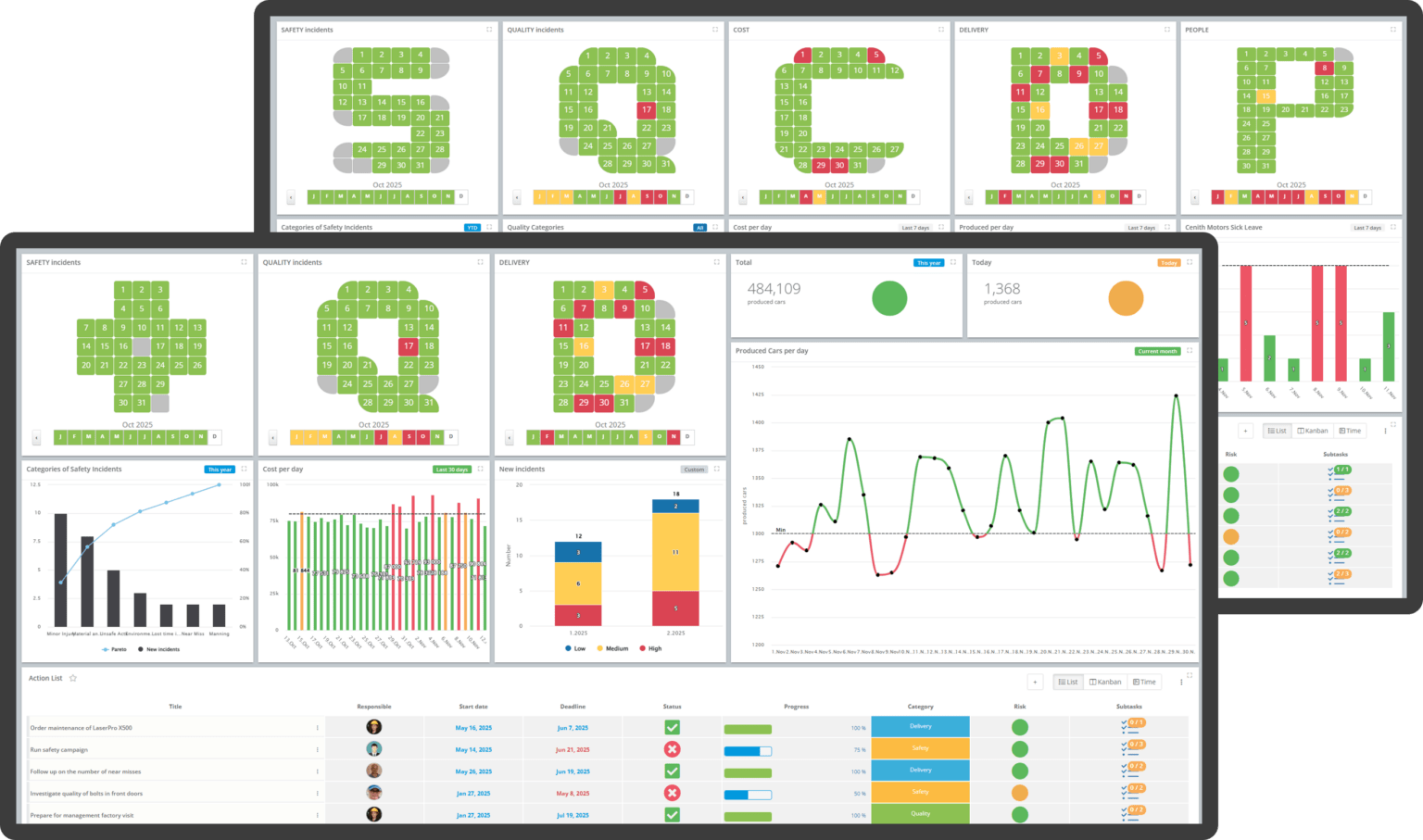
Many organizations achieve excellent results in a pilot plant but struggle when replicating success elsewhere.
Common barriers include:
| Challenge | Impact on Scaling |
|---|---|
| Different improvement processes per site | No common way of working |
| Manual boards and spreadsheets | Difficult to share information across locations |
| Limited visibility of plant performance | Leaders cannot identify systemic issues |
| Inconsistent problem-solving methods | Improvement quality varies dramatically |
| Lack of escalation structure | Problems remain local instead of being solved globally |
| Cultural differences between plants | Adoption rates vary significantly |
The larger the organization becomes, the more important standardization, transparency, and governance become.
A common mistake is individual improvement processes at different sites.
While local flexibility is important, the core framework should remain consistent.
A scalable continuous improvement system typically includes:
Think of it as a global operating system with local customization.
Instead of every plant choosing its own meeting structure:
| Element | Global Standard | Local Flexibility |
|---|---|---|
| Daily meeting cadence | Fixed | None |
| SQCDP categories | Fixed | None |
| KPI ownership | Fixed principle | Local assignment |
| Local goals | Variable | Allowed |
| Improvement projects | Variable | Allowed |
This approach ensures comparability while allowing plants to address unique operational needs.
Continuous improvement becomes difficult when sites operate in isolation.
Leaders need visibility into:
Without shared visibility, teams often solve the same problems repeatedly.
A multi-site view allows organizations to:
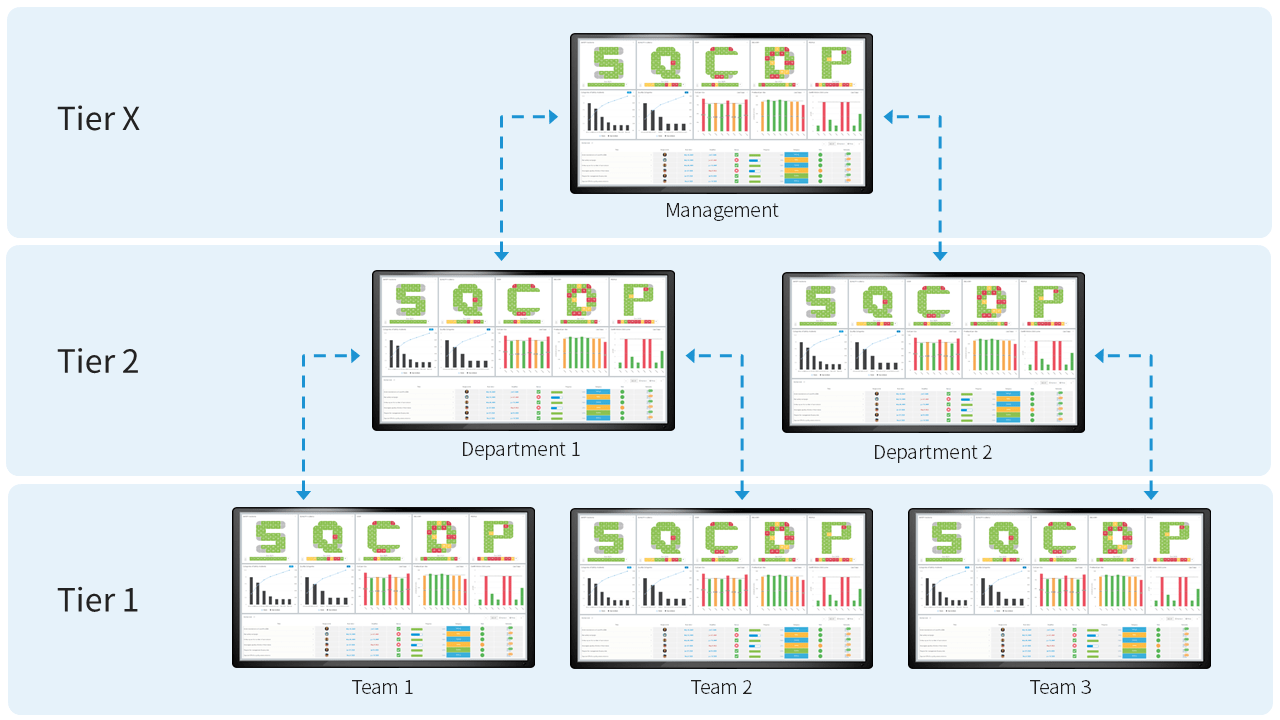
Many organizations scale improvement successfully through tiered daily management.
Problems should move through the organization based on urgency and complexity.
| Tier | Participants | Purpose |
|---|---|---|
| Tier 1 | Production teams | Daily operational issues |
| Tier 2 | Department managers | Cross-functional coordination |
| Tier 3 | Plant leadership | Strategic plant decisions |
| Tier 4 | Corporate operations | Multi-site alignment |
| Tier 5 | Executive leadership | Business-wide prioritization |
When escalation follows a consistent structure, problems are addressed at the right level instead of becoming buried inside individual departments.
Many companies attempt to expand Lean practices using:
These tools often work in one location but become difficult to manage across several facilities.
As the number of sites grows, manual administration increases exponentially.
Digital Lean management platforms eliminate many of these challenges by providing:
Without digitization, scaling continuous improvement often becomes an administrative burden rather than a performance strategy.
A useful example comes from a large global manufacturing organization Marquardt that adopted DigiLEAN to support Lean management and scale improvement practices.
When evaluating digital board solutions, Marquardt prioritized:
The team ultimately selected DigiLEAN because it supported these requirements and provided a scalable foundation for daily management and continuous improvement.
Before implementation, teams relied on:
As the organization expanded, leadership recognized these tools would become increasingly difficult to scale.
Rather than creating completely unique systems for every team, Marquardt worked toward a common standard while allowing limited local variation.
The goal was to create consistency without eliminating flexibility.
Mafquardt grew adoption of 10 locations in 2 months. Leaders reported that DigiLEAN helped accelerate continuous improvement by providing structure and making Lean practices easier to follow consistently.
Read the full customer story 👉 How Marquardt Standardized Global Shop Floor Management with DigiLEAN
Technology alone does not scale continuous improvement.
You also need people who advocate for the system.
A champion network should include:
| Role | Responsibility |
|---|---|
| Plant Manager | Drive accountability |
| CI Manager | Govern methodology |
| Department Leaders | Coach teams |
| Supervisors | Run daily routines |
| Local Champions | Support adoption |
| Corporate Improvement Team | Standardize best practices |
Champions help ensure improvement activities remain part of daily operations rather than side projects.
Many organizations track output metrics but ignore adoption metrics.
Both are important.
Monitoring both categories helps leaders determine whether the system itself is healthy.
One of the greatest benefits of multi-site continuous improvement is organizational learning.
Unfortunately, many successful improvements remain inside one facility.
Create a process that enables plants to share:
A structured knowledge-sharing process helps replicate success much faster than isolated experimentation.
The most successful organizations avoid two extremes:
Too Much Standardization
Too Much Flexibility
A practical guideline is:
| Area | Standardize | Customize |
|---|---|---|
| Daily management structure | ✅ | |
| SQCDP framework | ✅ | |
| Escalation process | ✅ | |
| KPI targets | ✅ | |
| Local improvement projects | ✅ | |
| Team workflows | ✅ |
This combination enables both consistency and engagement.
Scaling continuous improvement is not a deployment project – it is an ongoing leadership practice.
Organizations that succeed typically focus on:
When these elements work together, continuous improvement becomes a repeatable system that can grow with the organization.
As soon as a company operates more than one site, creating common standards becomes valuable. Waiting until improvement practices differ significantly between plants makes standardization much harder later.
Not necessarily. Core KPIs such as safety, quality, delivery, cost, and people metrics should usually be standardized, while local KPIs can be added to address site-specific challenges.
Many organizations focus on deploying tools instead of creating a repeatable management system. Successful scaling requires governance, leadership commitment, common standards, and regular coaching.
The timeline varies significantly based on company size, the number of plants, existing Lean maturity, and leadership alignment. Most organizations see better results by expanding in phases rather than attempting a company-wide rollout simultaneously.
You can watch DigiLEAN intro video to learn more, book a demo to walk through the workflow with an expert, or see the platform live by starting a free trial and exploring it yourself.