Tier meetings are designed to create visibility, enable escalation, and drive fast problem resolution across organizational levels.
Yet many organizations still struggle with why tier meetings fail – even when a formal structure exists.
The symptoms are familiar:
In most cases, tier meeting problems are structural – not cultural.
Let’s examine why ineffective tier meetings occur and what it takes to make them work consistently.
Many organizations have tier meetings. Fewer have tier meetings that actively control performance.
Common patterns include:
When meetings focus on explaining numbers rather than managing deviations, they stop functioning as control mechanisms.
Tier meetings fail when they lose their role in the management system.
Below is a structured overview of the most frequent failure patterns seen in daily management systems.
| Tier Meeting Problem | What It Looks Like | Operational Impact |
|---|---|---|
| Meetings Become Status Updates | KPIs read aloud, no deviation focus | No action triggered |
| No Clear Structure Across Tiers | Inconsistent agenda, unclear time limits | Escalation breaks down |
| Weak Action Ownership | Actions discussed but not assigned | Same issues reappear |
| Poor Visual Management | Outdated or manually updated boards | Loss of trust in data |
| Disconnected Escalation | Issues stall between tiers | Leadership surprised by risks |
You can recognize ineffective tier meetings quickly:
Contrast that with effective tier meetings:
| Ineffective Tier Meeting | Effective Tier Meeting |
|---|---|
| Reactive discussions | Proactive deviation management |
| Repeated issues | Clear resolution flow |
| Unclear ownership | Assigned owners & deadlines |
| Escalation confusion | Structured upward flow |
| No link to improvement | Clear path to structured problem solving |
Tier meetings are not standalone events. They are part of a daily management system.
When structure is strong:
When structure is weak, tier meetings fail – even with strong leadership.
Discipline and consistency are more important than charisma.
If you’re wondering how to improve tier meetings, start here.
| Action | Why It Matters |
|---|---|
| Clarify the purpose of each tier | Prevent overlap and confusion |
| Standardize agenda and time limits | Reduce variation |
| Focus only on deviations | Drive action instead of reporting |
| Assign clear owners and deadlines | Ensure accountability |
| Review open actions daily | Prevent repetition |
| Define escalation criteria | Create flow between tiers |
| Link recurring issues to structured problem solving | Reduce firefighting |
This checklist can be implemented immediately – without new tools.
Strong visual management reduces noise and increases focus.
Effective boards should:
However, maintaining visual consistency with manual boards can be demanding. Information may not always be updated in real time, and cross-shift visibility can become limited.
This is where digital visual management can strengthen the system.
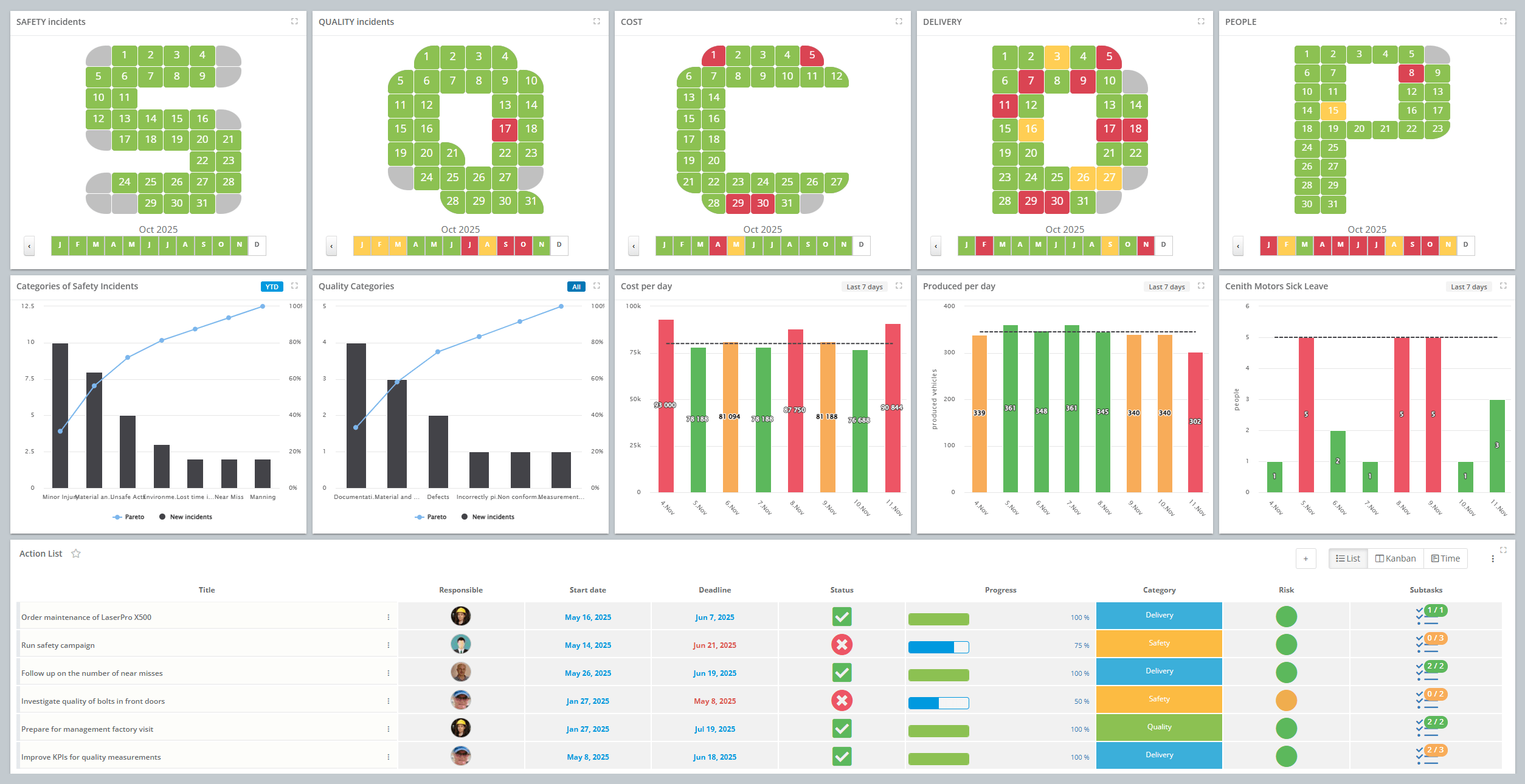
With DigiLEAN’s Interactive Boards, organizations can replace physical boards with fully customizable digital boards that remain automatically updated.
Digital tools are not a replacement for Lean fundamentals. They strengthen structure and discipline.
DigiLEAN supports structured tier meetings through the following capabilities:
| DigiLEAN Capability | How It Supports Tier Meetings | Operational Impact |
|---|---|---|
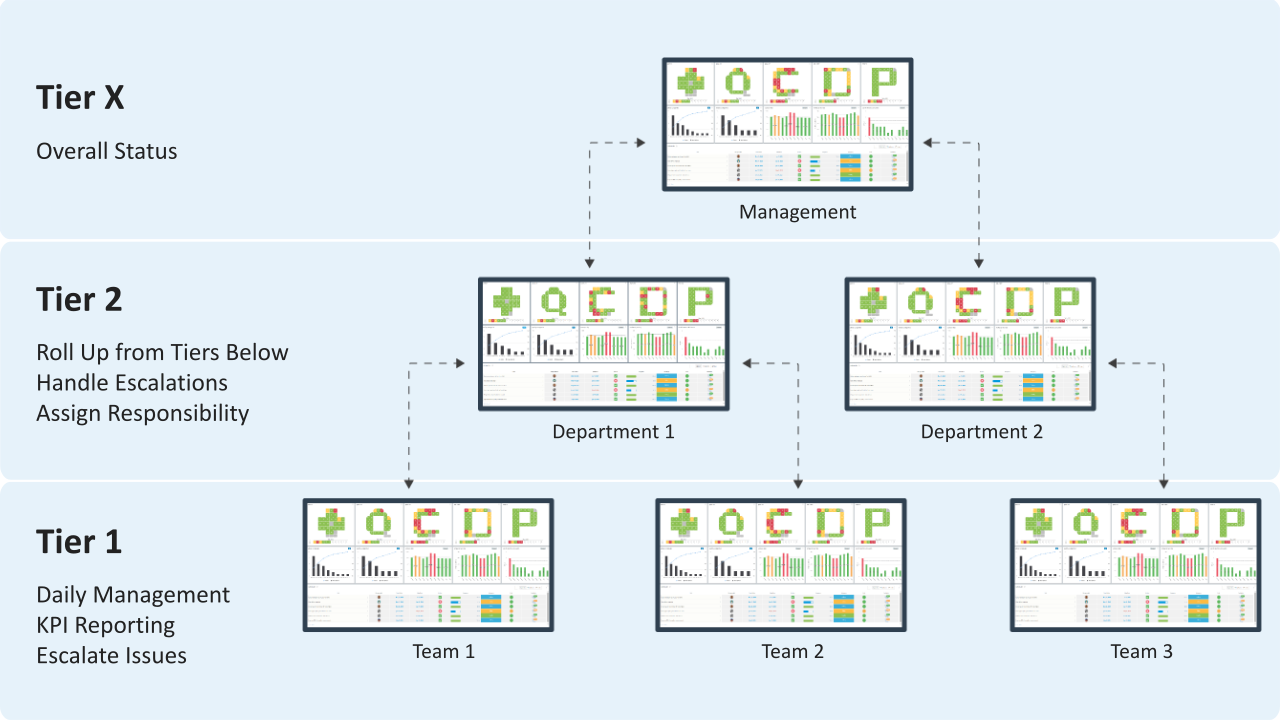
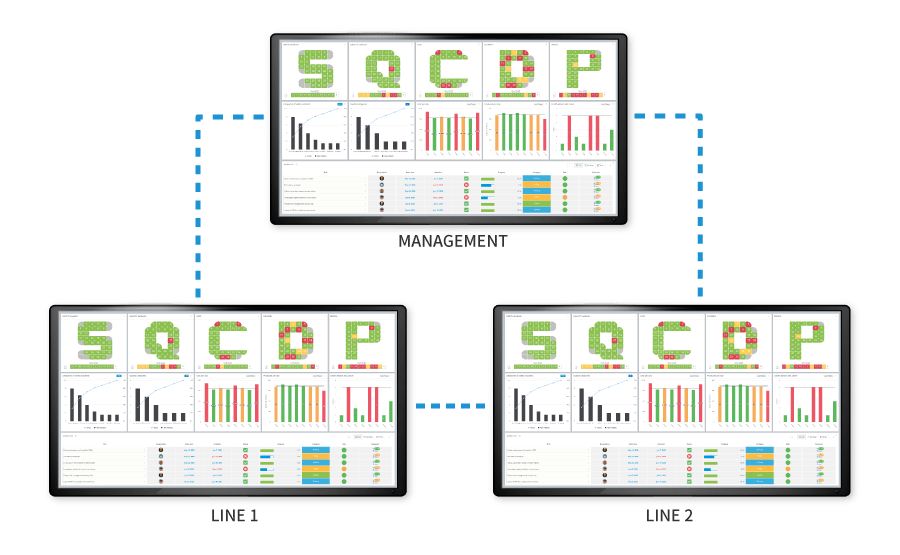
| Interactive Tier Boards | Fully customizable digital boards aligned across Tier 1, Tier 2, and management levels. KPIs, SQCDP views, actions, and escalations are visually connected between teams and departments. | Creates clear roll-up, structured escalation flow, and real-time performance visibility across tiers. |
| Improvements Module | Submit, prioritize, and track improvement ideas raised during tier meetings. | Ensures actions are followed up and not lost between meetings. |
| Incidents Module | Report and monitor incidents with visual statistics and follow-up processes. | Strengthens risk visibility and structured escalation. |
| A3 Problem Solving | Digital A3 templates support structured root cause analysis for recurring issues. | Moves repeated deviations from discussion to systematic resolution. |
| Projects & Strategy | Manage strategic initiatives and projects connected to escalated issues. | Aligns operational problems with higher-level priorities. |
| Learning & Standards | Create and share standards and one-point lessons. | Prevents recurring issues through structured knowledge sharing. |
| Mobile App | Access boards, tasks, improvements, and incidents on the shop floor. | Supports engagement and real-time updates across shifts. |
| Microsoft Teams Integration | Notifications and collaboration within Teams. | Improves response speed and cross-functional communication. |
| Enterprise-Ready Integration | Connect with existing IT systems and digital environments. | Ensures consistent and reliable data flow across tiers. |
By digitizing tier boards and linking actions, incidents, and problem-solving processes, DigiLEAN helps ensure that tier meetings remain structured management tools – not daily reporting rituals.
To summarize why tier meetings fail:
On the other hand, when ownership is clear, deviations are managed daily, and escalation flows smoothly across tiers, performance control improves.
Consistency determines success.
Digital support can help sustain that discipline and transparency – especially as organizations grow more complex.
Tier meetings should not be rituals. They should be operational control mechanisms.
Attendance should match the purpose of the tier.
Inviting too many participants can contribute to ineffective tier meetings. Only those who can make decisions or remove barriers should attend.
Yes – tier meetings can work with physical boards and manual processes. Many organizations have successfully used traditional visual management.
Challenges often arise when:
These are not the root causes of why tier meetings fail, but they can reinforce inconsistency and reduce transparency over time.
Measure operational outcomes – not meeting activity.
Ask:
If the same problems repeatedly appear without resolution, it is a clear signal of ineffective tier meetings.
Strong tier meetings reduce surprises, improve accountability, and create visible flow from problem identification to resolution.
You can watch DigiLEAN intro video to deepen your understanding of digital Tier boards, book a demo to walk through the workflow with an expert, or see digital Tier boards live by starting a free trial and exploring the platform yourself.