Across manufacturing and operations environments, Lean practices are well established. Daily stand-ups happen. KPIs are reviewed. Problems are discussed. A3s are written. Projects are launched.
But the tools behind them often haven’t evolved.
Operational Excellence leaders don’t need “another IT tool.” They need a digital infrastructure that supports daily management, structured problem solving, and continuous improvement – at scale.
Modern Lean software should strengthen your operating system, not replace it.
This guide will help you evaluate Lean platforms based on what truly matters for OpEx: structure, visibility, scalability, and real-world adoption.
OpEx professionals think in systems – not tools.
Before comparing solutions, step back and clarify your intent:
Your objectives define the criteria.
Ask yourself: What maturity level is my organization at the moment?
| Maturity Level | Description |
|---|---|
| Local Lean practices | Lean tools used within one team or department, often manually maintained. |
| Multi-site alignment | Standardized routines across plants, but limited visibility between them. |
| Enterprise-wide governance | Structured portfolio management, aligned KPIs, and visibility from frontline to leadership. |
Your software choice must match – and support – your desired maturity level.
Evaluate Lean software through the lens of Operational Excellence pillars.
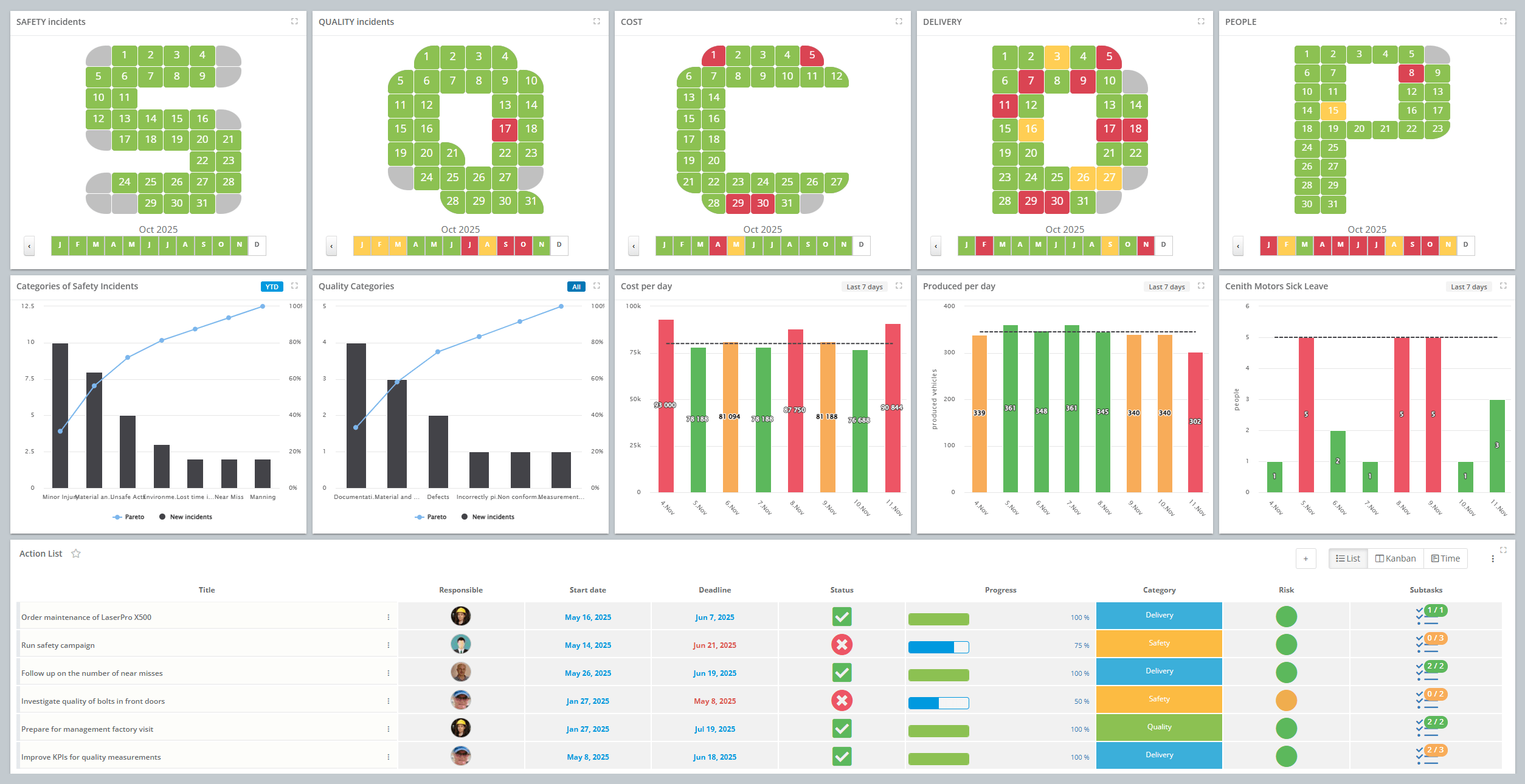
Visual management is non-negotiable in Lean.
Look for:
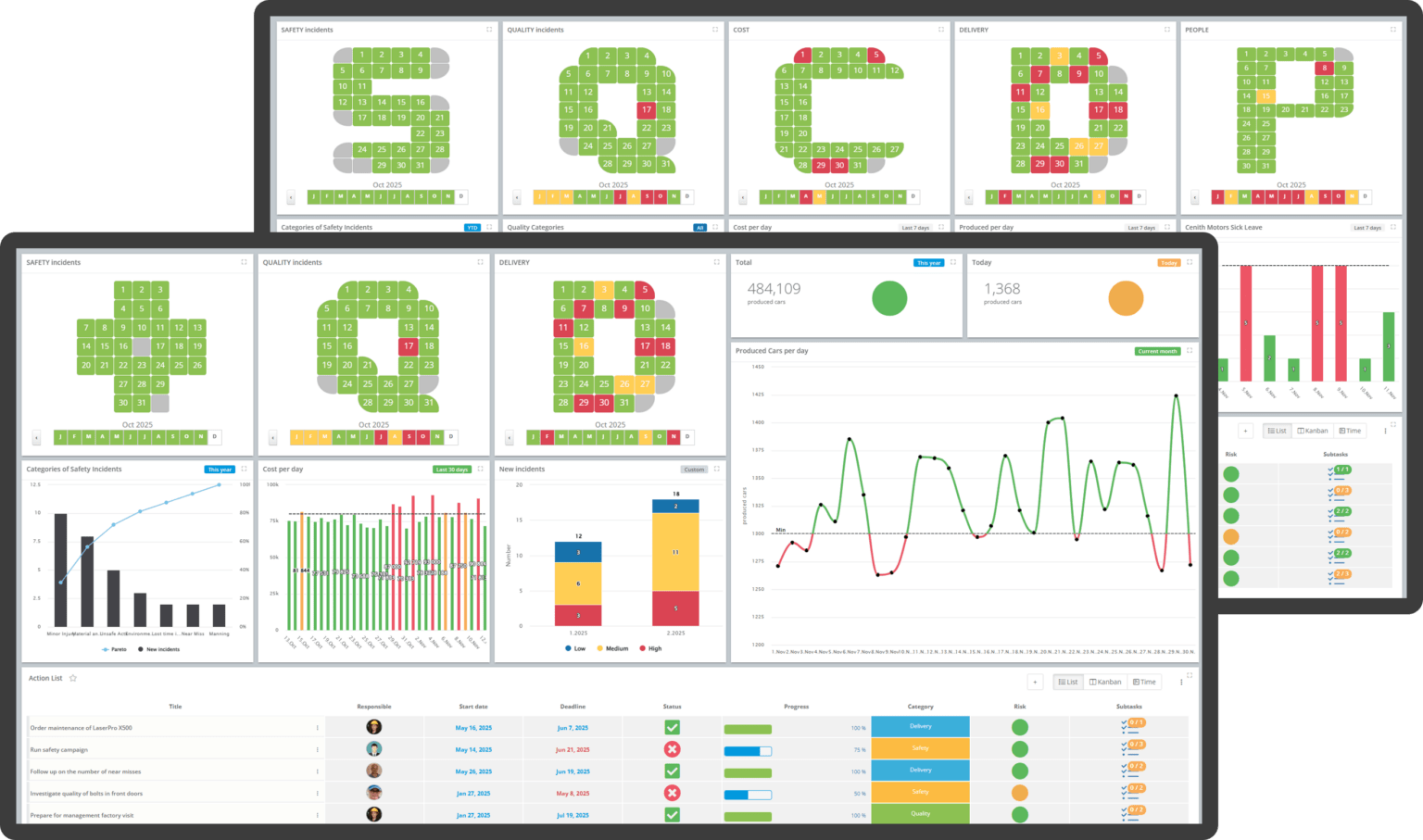
For example, platforms like DigiLEAN provide interactive boards that replace physical boards while staying automatically updated and accessible across teams.
Why it matters:
| Impact Area | Benefit |
|---|---|
| Alignment | Aligns teams across shifts, departments, and sites |
| Efficiency | Reduces manual updates |
| Transparency | Makes performance transparent |
| Accessibility | Ensures data is not locked in one location |
If visual management cannot scale digitally, your daily management cannot scale either.
Operational Excellence requires systematic improvement – not scattered ideas.
Look for:
Digital improvement modules, such as those offered in DigiLEAN, help ensure that ideas move from suggestion to implementation with transparency and accountability.
Why it matters:
| Risk Without Structure | Value With Digital Improvement |
|---|---|
| Lost improvements | Prevents “lost improvements” |
| Silos | Enables cross-functional collaboration |
| Weak ownership | Builds accountability |
| Isolated initiatives | Creates a shared improvement culture |
If improvements live in emails or spreadsheets, they are not part of a system – they are isolated activities.
For OpEx leaders, safety and quality incidents must drive learning – not just reporting.
Look for:
An integrated approach ensures that incidents feed directly into daily management and improvement workflows.
Why it matters:
| Outcome | Operational Effect |
|---|---|
| Faster response | Improves response time |
| Learning culture | Strengthens root cause culture |
| CI integration | Connects incidents to continuous improvement |
Incident management should not be separated from operational learning.
Operational Excellence depends on structured thinking.
Look for:
Digital A3 functionality, like that available in DigiLEAN, supports standardized problem-solving while ensuring transparency and collaboration.
Why it matters:
| Principle | Organizational Benefit |
|---|---|
| Standardization | Standardizes methodology across sites |
| Consistency | Increases cross-site consistency |
| Transparency | Makes decision-making visible |
| Knowledge retention | Builds long-term knowledge retention |
A3s should not disappear into folders. They should remain accessible learning assets.
This is especially critical for OpEx leaders responsible for governance and portfolio oversight.
Look for:
Digital modules for projects and strategy – such as those available in DigiLEAN – help connect frontline improvements to enterprise priorities.
Why it matters:
| Strategic Risk | Digital Alignment Benefit |
|---|---|
| Strategy disconnected from operations | Prevents strategy from becoming disconnected from operations |
| Limited execution visibility | Makes execution visible |
| Weak governance | Enables structured governance at scale |
If leadership cannot see how daily actions support strategy, alignment is at risk.
Engagement drives results.
Look for:
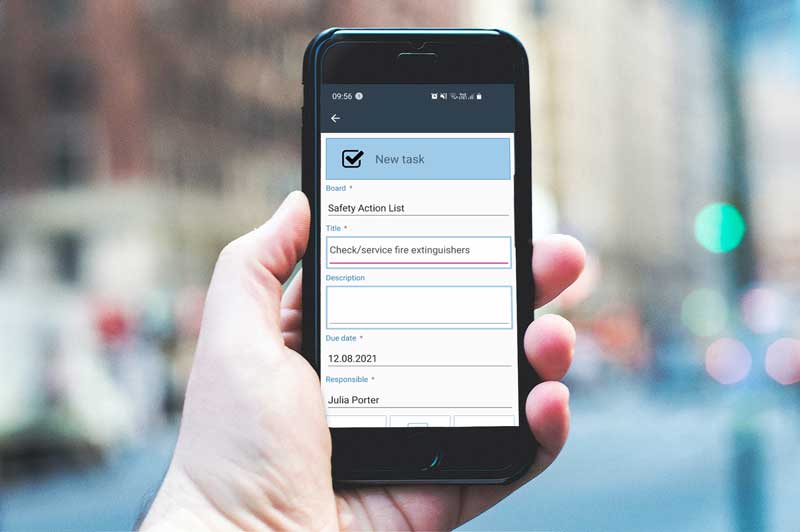
With mobile functionality – such as the mobile app provided by DigiLEAN – frontline teams can participate in improvement processes directly from their work environment.
Why it matters:
| Engagement Driver | Result |
|---|---|
| Accessibility | Strengthens participation |
| Real-time reporting | Reduces reporting delays |
| Visibility | Connects frontline to leadership |
| Data accuracy | Increases data accuracy |
If your system is only accessible from a desktop, you risk excluding the people closest to the process.
OpEx leaders must think enterprise-wide.
Look for:
For example, DigiLEAN supports Microsoft Teams integration and enterprise-ready connections, enabling interoperability within the organization’s digital environment.
Why it matters:
| Integration Factor | Benefit |
|---|---|
| Connected systems | Avoids siloed systems |
| Collaboration | Supports collaboration |
| Scalability | Ensures scalability |
| Efficiency | Reduces duplication of effort |
Lean software should strengthen your digital ecosystem – not fragment it.
Even the most capable platform fails without adoption.
Evaluate:
Operational Excellence is behavioural. The right platform should:
Adoption is not just about usability. It is about whether the software strengthens daily behaviour.
For enterprise organizations, governance and security are non-negotiable.
OpEx leaders should ensure that:
For example, DigiLEAN is ISO 27001 certified, reflecting a structured and internationally recognized approach to information security management. It is also used by enterprise organizations such as Marquardt and Kavli, demonstrating applicability in complex, multi-site operational environments.
When digital Lean becomes part of your operating backbone – it must meet enterprise expectations.
Experienced OpEx professionals should be cautious of:
| Red Flag | Why It Matters |
|---|---|
| Generic project management tools labeled as “Lean” | Lack of structured Lean workflows |
| Limited visual management capabilities | Weak daily management support |
| No structured problem-solving workflows | Inconsistent root cause work |
| Weak alignment between strategy and daily operations | Governance gaps |
| Overly complex systems that hinder adoption | Low engagement and usage |
If the system does not reflect Lean principles in structure and workflow, it will not strengthen your operating model.
Before making a decision, ask:
| Critical Question | Yes / No |
|---|---|
| Does this platform strengthen daily management? | |
| Can it scale across sites and departments? | |
| Does it standardize problem solving? | |
| Does it connect strategy to execution? | |
| Will frontline teams actually use it? | |
| Does it reduce manual work? |
If you cannot clearly answer “yes” to these, continue evaluating.
Lean software is not about digitizing boards.
It is about strengthening your operational system.
For Operational Excellence professionals, the real question becomes:
Does this platform improve structure, visibility, accountability, and alignment across the organization?
When the answer is yes, you are not just implementing software.
You are reinforcing the foundation of daily management, structured problem solving, and continuous improvement – at scale.
It depends on scope. A focused rollout (e.g., daily management boards) can be implemented relatively quickly. Multi-site or enterprise-wide deployment requires more structured onboarding and alignment.
The key is starting with a clear use case and scaling step by step.
Usually not. A phased approach is more sustainable.
Many organizations begin with daily management or improvement tracking, then expand into A3 problem solving and strategy alignment once adoption is stable.
Look for operational impact, not just system usage:
If transparency and accountability improve, the system is delivering value.
Both play a role.
IT ensures security and integration.
OpEx defines workflows, standards, and governance.
Operational ownership is critical to ensure the platform strengthens daily Lean routines.
You can watch DigiLEAN intro video to deepen your understanding of Lean software functionality and use cases, book a demo to walk through the workflow with an expert, or experience Lean software live by starting a free trial and exploring the platform yourself.