Organizational changes are extremely complex, challenging and time consuming. Performing a lean digital transformation is fully depending on your executives’ support, and even then, you will face many obstacles and you may fail along the way.
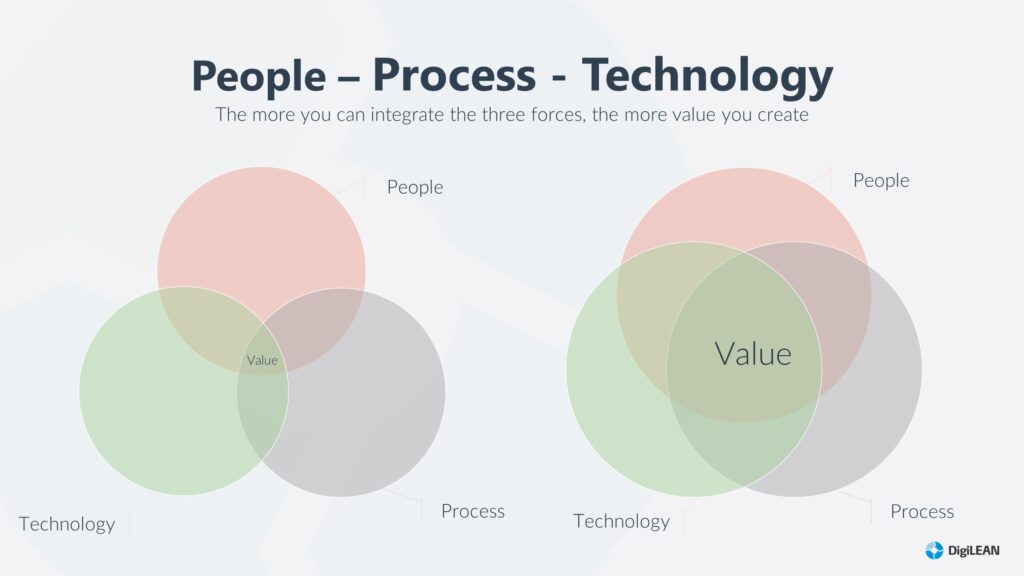
The people, process, technology framework predicts three prioritized areas:
You can consider the model as a stool with three legs, each leg important to support the rest. Organizations that don’t have the people engaged and the lean thinking in place, or the processes ordered, they are setup for a digital transformation failure.
You have to pay attention to the people first. Your people are the ones creating value, the ones that get things done, the ones that use the tools and follow the process.

Our minds are built to seek comfort, stability, and predictability. Therefore, any change in process, tools or organization is considered a threat. We get defensive.
How we act on this can be very different depending on our culture, affected by our role, position, implicit or explicit expectations, personal wellbeing, and daily mood just to mention a few.
Working from top down is the best approach. You must get the buy-in and ownership amongst the whole leadership in order make a sustainable change for the frontline workers.
Even if lean is about empowering the frontline workers, they cannot become autonomous problem solvers if the leaders don’t see eye-to-eye.
To help with people’s need for stability and safety, processes and standardization creates predictability and reduce stress.
In many companies, the processes are not standardized. The job is done «as we’ve always done it». A standardized process helps gather the teams and improves communication. Once you have a process to refer to, it’s easier to discuss problems and improvements on the process.
Going digital will affect your processes. People must make a change in the way they work, the tools they use, and you have to go through a new learning cycle.
To change a process, you depend on the leadership to fully take ownership in the new process and the change process itself. It is also crucial to involve, engage and demonstrate the purpose and benefits to get the frontline workers onboard with it.
There will be failures. You are depending on the frontline workers, but you cannot force their hands to do something they won’t do. You can’t force them to use a new tool unless their job depends on it. These people can stand in the way of success and can be very difficult to work with in a digital transformation.
With clear processes, it’s much easier to identify waste, improvement areas and best practices.
This is the most common attitude when it comes to technology. But technology is also much more than IT systems. It’s about tools, the things you use to get the job done.
In this context though, we are facing a change, either replacing your ERP system or adding a new systems to your portfolio. The process and reactions are much the same.
Why?
Why, why, why, why?
This is always the right question to ask, and if you can answer this, you are much more likely to succeed. All changes are done for a reason. They have a purpose, and this must be communicated repeatedly throughout the whole process. This rule counts for both working with people and processes, but perhaps it is most prominent when it comes to technology.
Clarity comes in the perspective of what was the problem, what is the solution, and how are these changes moving us towards the solution.
Value is created where people with the right mindset, skills, motivation and autonomy works together in a process supported with tools and technology.
Tightening the relationship between people, process and technology adds capabilities to your organization to become more innovative and create more value.