
Run daily meetings on boards.
Capture, prioritize and follow up improvements.
Report incidents and see trends over time.
Customized templates for problem solving.
Run gemba walks and 5S audits and report on the results.
Operationalize your strategies and integrate your teams.
Manage projects and project portfolios with visual tools.
Create and share best practices and standards.
Easy access to tasks, improvements and incidents.
Access your tools in Microsoft Teams.
Support visibility, ownership, and improvement.
See your key operational KPIs at a glance.
Align daily operations, performance, and actions.
Standardize, scale, and sustain Operational Excellence.
Interactive tools for both shop floor and administration.
Maintain standards. Manage incidents and discrepancies.
Lean daily management tailored for healthcare.
We have a LEAN solution for you too. Just ask!

A 5S audit is a regular check of one work area against the five S’s: Sort, Set in order, Shine, Standardize and Sustain. You walk the area with a checklist, answer the questions and give each S a score.
This is the 5S audit checklist we would start with, and how we would set it up.
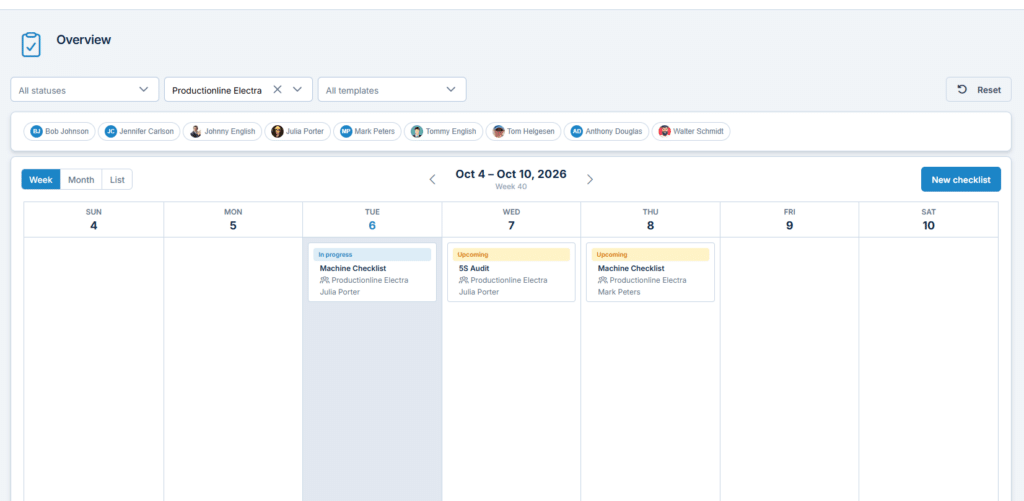
Two questions per S. Add or swap questions so they fit your area, but try to keep it under 20. Long audits tend to get skipped.
It is especially relevant for teams experiencing challenges such as unclear escalation, weak follow-up, or meetings that focus more on reporting than on solving problems.
| S | Question |
|---|---|
| Sort | Is there anything here that is not used on this line? |
| Have red-tagged items been dealt with? | |
| Set in order | Does every tool have a marked place? |
| Is everything in its place right now? | |
| Shine | Is the area clean during normal work, not just after cleaning? |
| Are leaks and wear written down when someone finds them? | |
| Standardize | Is there a photo of how the area should look? |
| Does the area match the photo today? | |
| Sustain | Was the last audit done on time? |
| Were the actions from the last audit closed? |
Decide where the area starts and stops, for example “line 2, from the material rack to the packing table”. Then everyone audits the same thing.
“Is the area tidy?” depends on who you ask. “Are there items on the bench that are not used on this shift?” is easier to answer the same way. If you and a colleague answer a question differently, rewrite it.
For example the shadow board with all tools in place. Then it is easy to say yes or no.
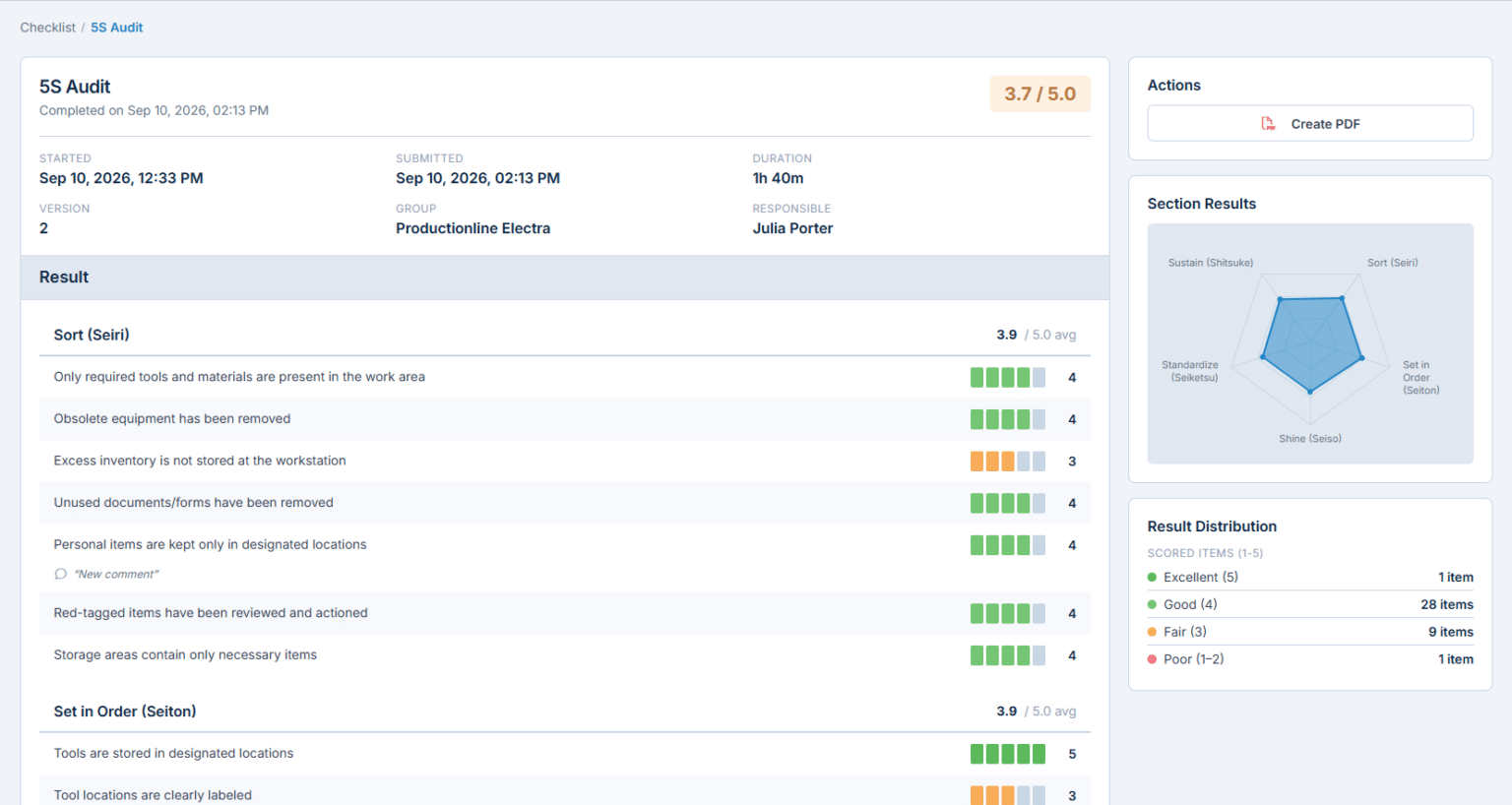
Look at the score for each S, not only the total. If most of the missing points are in Sustain, that is where to start.
Give the audit a fixed day and a name. We would start with the team leader every week and a manager once a month.
Walk the area and score each question where you stand. Take a photo and write a short comment on every fail or low score, so the person who follows up knows what you saw.
Follow up every point that is below standard. Create a follow-up task for each one, with a responsible person and a deadline. Put the score and the open tasks on the daily management board
After a few audits, look at the score over time, whether the audits were done on the planned day, and whether the actions were closed. That shows if the area is improving or slipping.
Pass/fail is easier when you start. A 1 to 5 scale shows smaller changes, and most teams use it once the audit is routine.
Weekly is a good start for the team in the area, with a manager joining once a month. Pick a frequency you can keep.